


RELATED PRODUCTS
WAN emulation & Teleprotection
Explore Net.Storm, the portable WAN emulator to validate teleprotection, and IEC 61850. Engineers can reproduce delay, errors, jitter, loss and bandwidth limitations to verify how critical infrastructure behaves under realistic network conditions.
BARCELONA, MARCH 12th, 2026
Commissioning Teleprotection
Why Utilities are using WAN emulation to validate Teleprotection architectures.
Modern electrical utilities increasingly rely on packet-based communication networks to transport operational data, synchronization signals and teleprotection commands. These systems are essential for maintaining grid stability and ensuring rapid response to faults in the power system.
Unlike traditional dedicated TDM infrastructures, packet networks introduce impairments such as delay variation, packet loss, duplication, reordering and asymmetric delays. These effects can directly influence the behaviour of protection systems. For this reason, utilities must validate how protection and automation equipment behaves under realistic network conditions before systems are commissioned. WAN emulation plays a critical role in this validation process.
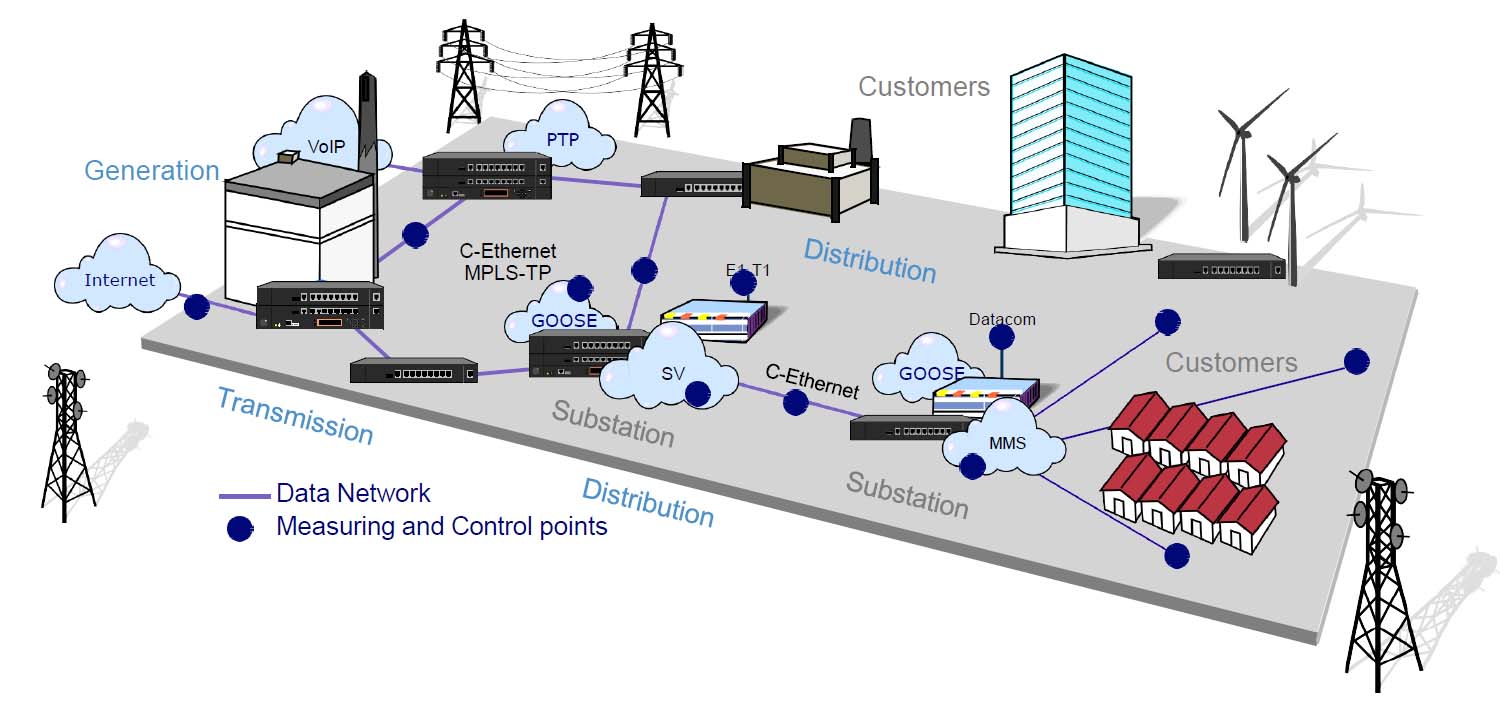
Fig 1. Utilities must verify in the lab and in the field how protection and synchronization systems behave under real network conditions.
The Utility Network Challenge
In modern Smart Grid architectures, protection, automation and synchronization devices increasingly operate over Ethernet-based communication infrastructures.
Utilities must therefore verify both in laboratory environments and during field commissioning how their equipment behaves under variable network conditions.
Several challenges arise in this context:
- TDM networks provide predictable QoS but lack flexibility and efficiency.
- Packet networks offer efficiency but degrade QoS and requires engineering.
- Validation of IEDs, clocks and teleprotection is a must.
- Commissioning to reproduce realistic traffic conditions in a controlled manner.
Without this type of validation, commissioning of critical infrastructure networks becomes significantly more risky.
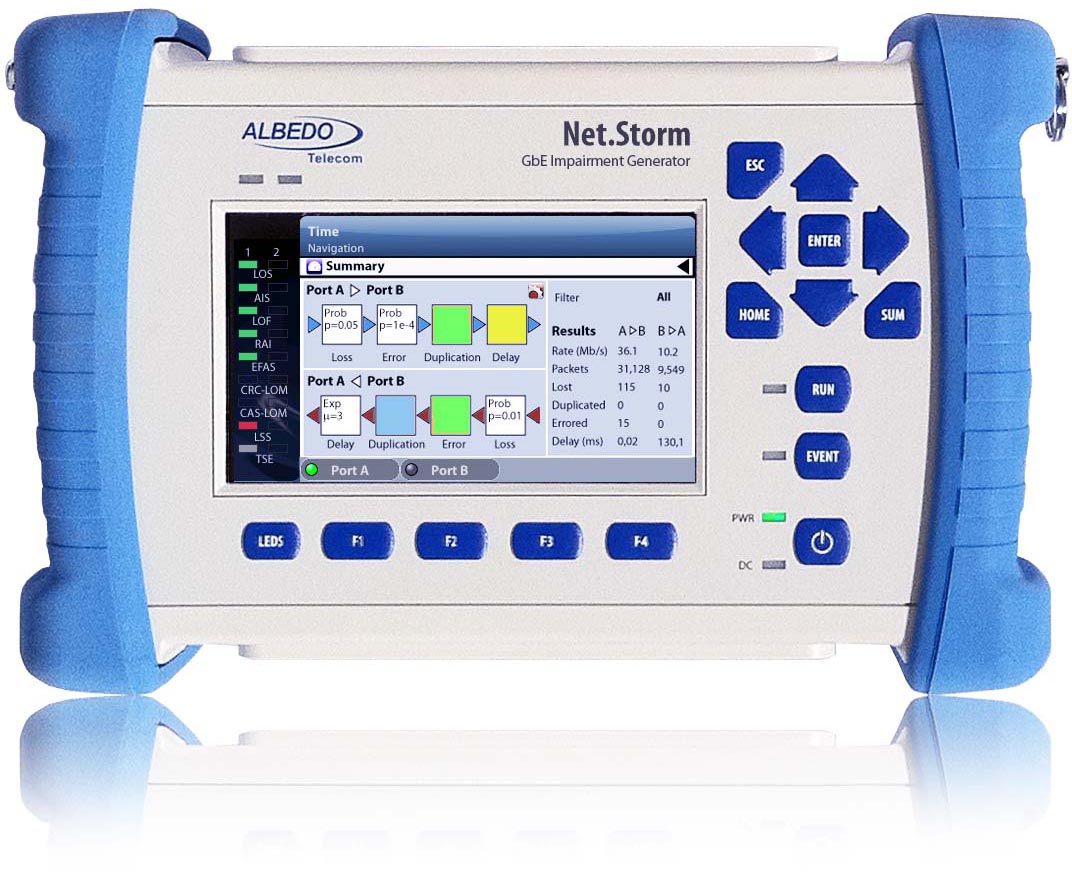
Fig 2. Net.Storm simulates links and networks in terms of bandwidth and QoS.
Why WAN Emulation Matters
WAN emulators allow engineers to reproduce realistic network conditions during system validation and commissioning. They simulate communication links and networks by controlling bandwidth and introducing impairments that affect traffic flows.
Traffic can be separated into independent flows using configurable filters. Each flow can then receive specific treatment in order to replicate real-world network behaviour.
Typical impairments that can be simulated include:
- Packet loss using single, statistical or burst loss models
- Delay based on deterministic or random distributions
- Jitter to emulate packet delay variation
- Packet reordering associated with variable delays
- Packet duplication using probability-based mechanisms
- Bit errors using configurable error probabilities
By reproducing these conditions either in the laboratory or during field installation, engineers can validate how devices behave before they are deployed in substations or control centres.
This significantly reduces operational risk and ensures that protection systems will behave correctly once installed in live networks.
Net.Storm: WAN Emulation for Field Engineers
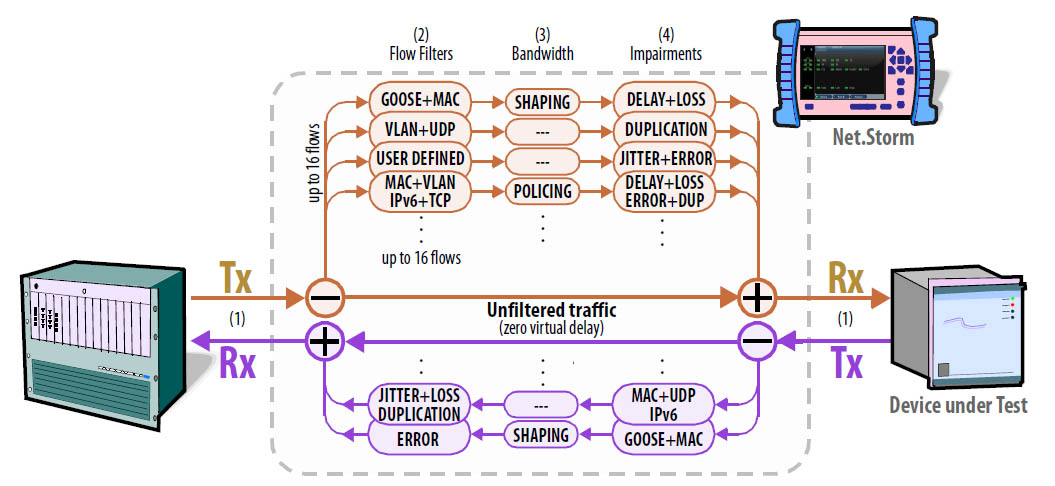
Fig 3. Traffic is separated by user-defined filters into independent flows that receive specific treatment to replicate real-world traffic conditions.
Traditional WAN emulators are typically designed for laboratory environments. They are often large, expensive and complex instruments intended for use in dedicated testing facilities. ALBEDO developed Net.Storm with a different philosophy: bringing WAN emulation directly to the field. Net.Storm is designed as a portable and self-contained platform that allows engineers to perform WAN impairment testing wherever the network is being deployed.
Key characteristics include:
- Fully portable handheld platform with integrated touch screen and keyboard
- Self-contained operation with no need for external laptops or controllers
- Battery-powered design suitable for field installations and substations
- Suitable for both laboratory validation and on-site commissioning
- Zero virtual delay for traffic flows not affected by the configured impairments
- Firmware-based processing engines capable of handling traffic deterministically
Unlike software-based emulation platforms, hardware-based processing ensures deterministic behaviour even when operating at higher traffic rates. This architecture allows engineers to reproduce realistic network conditions directly during installation and commissioning activities.
Validating Critical Substation Equipment
WAN emulation plays a key role in validating communication behaviour of devices deployed in modern substations. Using Net.Storm, engineers can verify the behaviour of:
- Synchronization clocks and PTP networks
- Protection IEDs and teleprotection equipment
- Network infrastructures transporting operational traffic
- IEC 61850 communication environments
- GOOSE messaging performance
- PTP or NTP timing distribution networks
- Wireless links introducing variable delay or packet loss
By reproducing realistic WAN conditions, engineers can observe how equipment reacts before the system becomes operational.
This capability is particularly valuable when commissioning complex IEC 61850-based substations, where network behaviour can directly affect protection response. Net.Storm performs all operations using firmware-based processing engines with microsecond accuracy, ensuring precise and repeatable testing conditions.

Fig 4. Teleprotection systems are extremely sensitive to network delay symmetry.
The Teleprotection Challenge
Teleprotection systems are extremely sensitive to network delay symmetry. Modern implementations frequently use GOOSE messaging over Ethernet, while many utilities continue to operate legacy C37.94 TDM-based protection systems.
When these systems are transported over packet networks, by means of pseudo-wires based on MPLS, the result can be acceptable bearing in mind that MPLS is based on Ethernet and it can introduce asymmetric delays between communication paths. Teleprotection schemes rely on comparing electrical parameters measured at both ends of the protected infrastructure, such as voltage (V), current (I) and impedance (Z). For these comparisons to be valid, the measurements must correspond to the same instant in time at both locations. Each measurement is therefore time-referenced so that values measured at point A and point B can be evaluated synchronously.
If the parameters differ beyond expected limits. For example if I(A)≠I(B) or V(A)≠V(B), or Z(A)≠Z(B) the system may interpret this as a fault condition inside the protected zone and trigger the protection mechanism.
For this reason, teleprotection systems depend critically on accurate time synchronization and symmetric communication delays. Any delay asymmetry between the two communication paths can distort the time relationship between the measurements, potentially leading to incorrect comparisons and undesired protection actions. Ensuring delay symmetry is therefore a fundamental requirement during network commissioning.
Testing Delay Symmetry
Some modern routers manufactured by vendors such as Nokia incorporate mechanisms designed to compensate for asymmetric delay and maintain balanced communication paths. However, these mechanisms must be validated during commissioning in order to determine their operational limits and ensure that protection systems will operate reliably.
Testing these conditions requires the ability to precisely simulate delay scenarios, including controlled asymmetry between forward and reverse communication paths.
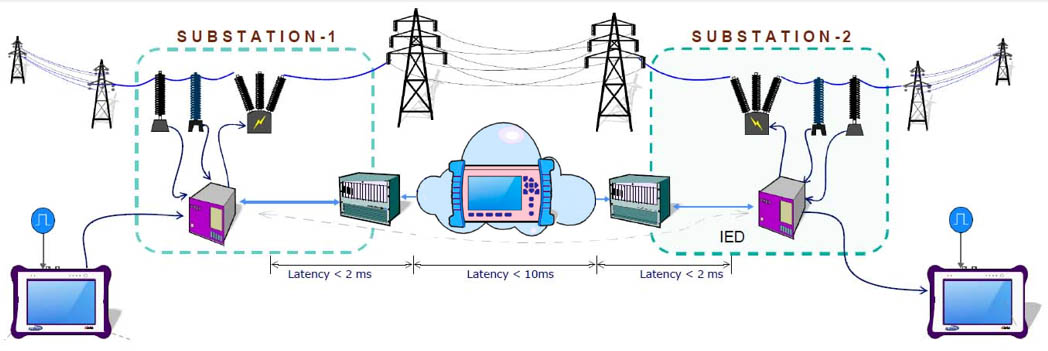
Fig 5. Teleprotection systems are extremely sensitive to network delay symmetry.
The Key Capability: Controlled Asymmetric Delay
One of the most important capabilities of a WAN emulator used in utility networks is the ability to generate controlled asymmetric delay. Net.Storm allows engineers to introduce Packet errors, Jitter, Packet loss, Bandwidth limitations and Asymmetric delay between communication directions. This is the ways to reproduce realistic network scenarios and verify teleprotection behaviour under real operating conditions.
Portable WAN Emulation for Utilities
Utilities evaluating WAN emulation solutions often consider traditional laboratory platforms such as those from Keysight / IXIA / Calnex. These systems provide powerful capabilities but are typically expensive, complex and bulky. However, Net.Storm offers a different approach. Its architecture replicates the behaviour of routers and gateways that regulate bandwidth and prioritise traffic flows using well-known mechanisms such as token bucket algorithms.
Two key traffic control mechanisms are implemented:
- Traffic Policing: Packets that exceed the configured bandwidth limit are discarded while maintaining the timing of the traffic stream.
- Traffic Shaping: Packets that exceed the configured bandwidth limit are buffered and transmitted later, introducing controlled delay without loss if buffers are not exceeded.
This capability allows utilities to validate protection networks and verify delay symmetry requirements both in the laboratory and directly in the field.
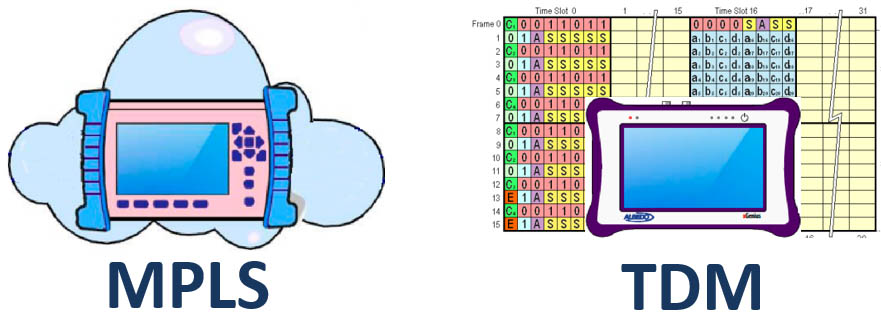
Fig 6. Choosing the right tool to generate asymetric delays: Net.Storm for Ethernet / MPLS and xGenius for TDM / C37.94 channels.
Conclusions
- Reliable teleprotection requires precise control and validation of network conditions therefore Utilities must verify how IEDs, clocks and protection systems behave under realistic WAN impairments before commissioning critical communication infrastructures.
- Portable Net.Storm WAN emulation allows engineers to reproduce delay asymmetry, jitter and packet loss scenarios both in laboratory environments and directly at the installation site.
- By bringing WAN emulation from the laboratory to the field, Net.Storm enables utilities to commission protection networks with greater confidence and lower operational risk.
Utilities, Integrators and Manufacturers are using Net.Storm: Schneider, GE, EGAT, ZTI… and many others.