


RELATED PRODUCTS
ALBEDO is testing HDLC
XGenius is expanding its synchronous serial testing capabilities with HDLC support to help engineers verify framed communications in power utilities, telecommunications and critical infrastructure.
MIAMI, OCT 12th, 2026
HDLC: a classic protocol still in use today
In the early days of digital communications, transmitting data between computers and remote equipment was not as simple as it is today. Serial links carried continuous streams of bits. How could a receiver distinguish one message from another? How could transmission errors be detected? How could two devices coordinate the exchange of information?
These challenges led to the development of High-Level Data Link Control (HDLC), a standardized, bit-oriented protocol based on earlier developments, such as IBM’s SDLC (Synchronous Data Link Control), which has been used as Layer 2 in SNA networks since the ’70s.

Fig 1. HDLC was built upon SDLC, an earlier development of IBM’s SNA architecture.
HDLC introduced a structured approach to serial communications by providing framing, addressing, error detection, and link-control procedures. Its principles have influenced many subsequent protocols and remain relevant more than fifty years later.
How does HDLC work?
HHDLC operates at the data link layer (layer 2) of the OSI model. It organizes the continuous bit stream into individual frames. Each frame contains:
- Flag: a distinctive 8-bit sequence hexa 7E marking frame boundaries
- Address: identifies a station on the link
- Control: used for link management depending on the procedure
- Information: contains the data being transported
- FCS: it is a CRC to detect transmission errors

Fig 2. HDLC frame structure
If the data contains the same bit pattern as the flag (7Ex), bit stuffing is used, and the transmitter inserts a zero after every five consecutive ones within the frame. The receiver then removes these inserted bits to ensure that the user data is not confused with the frame delimiters. This mechanism enables HDLC to carry any binary information.
Depending on the implementation, HDLC can also provide flow control, acknowledgments, and retransmission. However, many applications use HDLC framing without implementing all of its original link-control procedures.
Where Is HDLC Still Used?
Although Ethernet and IP have replaced many traditional serial networks, High Level Data Link Control (HDLC) based communications are still present in telecommunications and industrial infrastructure.
- Power utilities, for example, serial communications are still found in protection, control, and automation systems. Certain legacy equipment and communication arrangements use HDLC or HDLC-derived framing to exchange information over synchronous serial links.
- Telecommunications, HDLC and related framing techniques have historically supported point-to-point wide area network (WAN) connections and the transport of data through digital transmission networks.
Other applications include industrial control systems, railway communications, and specialized equipment with long operational lifetimes. In these environments, replacing an existing serial infrastructure involves more than just changing a communication interface. Interoperability, reliability, certification, and service continuity must all be considered.
Testing HDLC Communications
Even when the physical serial connection is functioning properly, communication issues may arise at the data link layer. For example, there may be incorrect framing, incompatible configurations, or transmission errors that can lead to lost or invalid frames. These problems may be difficult to identify by measuring only the physical signal. Therefore, engineers need to verify the characteristics of the HDLC traffic itself:
- Count: the number of frames transmitted or received
- Invalids: frames that fail the applicable validity checks
- Rate: the number of frames processed per second
- Configuration: compatibility between the framing parameters
These measurements are useful when commissioning links, integrating equipment from different suppliers or troubleshooting existing services.
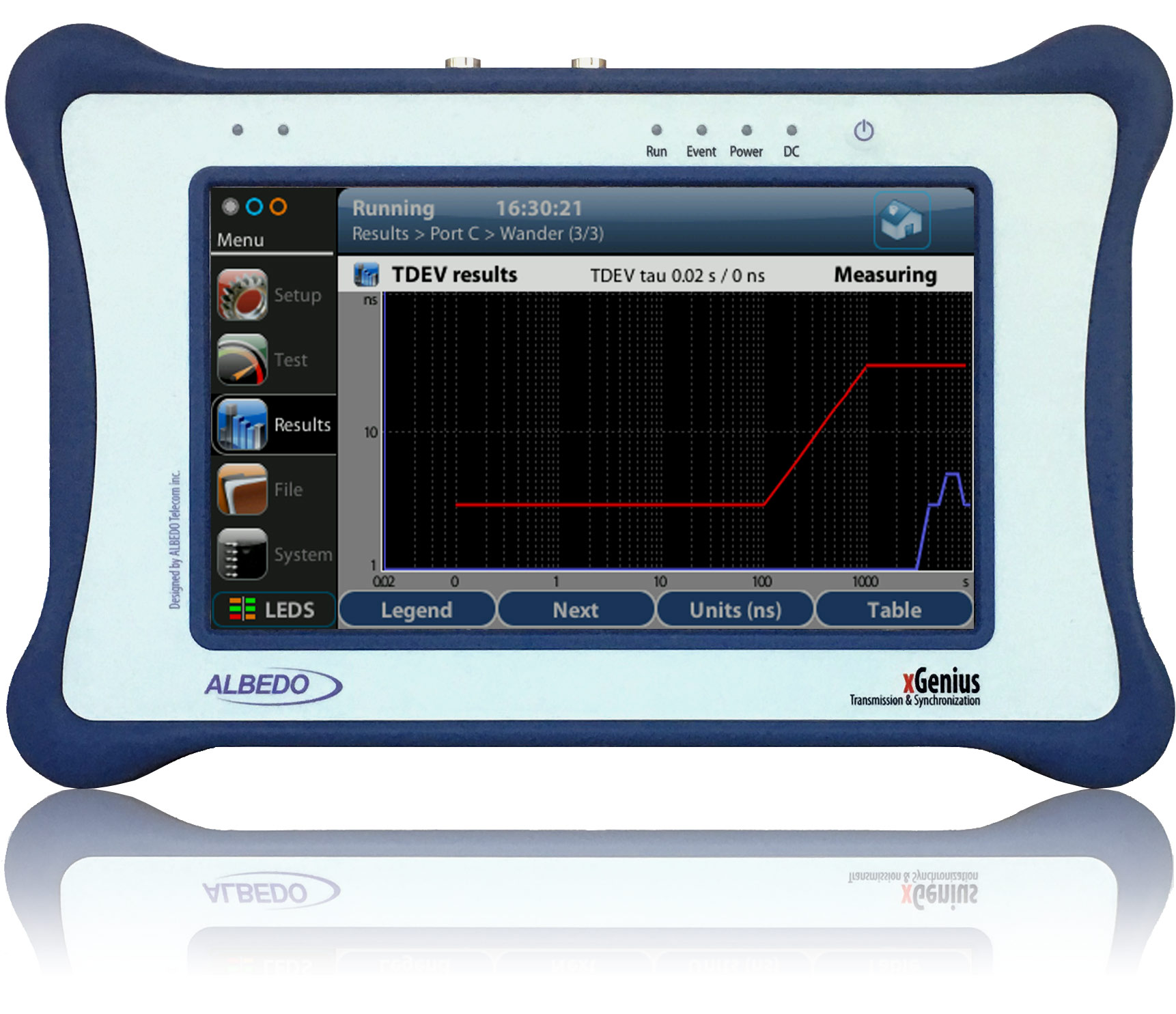
Fig 3. Zeus & xGenius add HDLC testing.
HDLC Testing with xGenius
xGenius now supports HDLC encapsulation testing over multiple synchronous interfaces such as V.24/V.28, X.21/V.11, V.35, V.36 (RS-449), EIA-530 and EIA-530A, with bit rates up to 10 Mb/s, depending on the interface. Engineers can configure the transmission bit rate, frame length, address and control fields, allowing HDLC-framed traffic to be generated and analyzed under different test conditions. These capabilities allow to verify not only the integrity of HDLC frames, but also the performance of the underlying communication link, particularly when commissioning new equipment, troubleshooting transmission errors or validating network changes.
In addition to monitoring frame counts, invalid frames and frame rates, xGenius supports BER and performance measurements, latency testing and service disruption time testing. By combining HDLC framing with comprehensive synchronous serial testing, xGenius provides a practical tool for maintaining critical communications in power utilities, telecommunications and industrial networks.
Technology evolves, but the need for reliable communication does not.